The Other Face of Sustainability: Climate Justice and the Power of Local Resistance
Today, the concept of “sustainability” has unfortunately been largely reduced to corporate greenwashing strategies, carbon-neutral targets, or merely renewable energy investments (Klein, 2015). However, while solar panels or electric vehicles may offer a response to the technical dimension of the ecological crisis, they cannot heal the deep social wounds at its core. True sustainability begins with rejecting the paradigm that views nature merely as a “resource” and humans merely as “consumers.”
At this point, the concept of “Climate Justice” comes into play. Climate justice approaches sustainability not as an engineering problem, but as a struggle for human rights and social equality. Although climate change recognizes no borders, its impacts are profoundly unequal. Those most affected by droughts, floods, and food crises caused by global warming are disadvantaged communities and countries of the Global South that have contributed least to the crisis (Martinez-Alier, 2014).
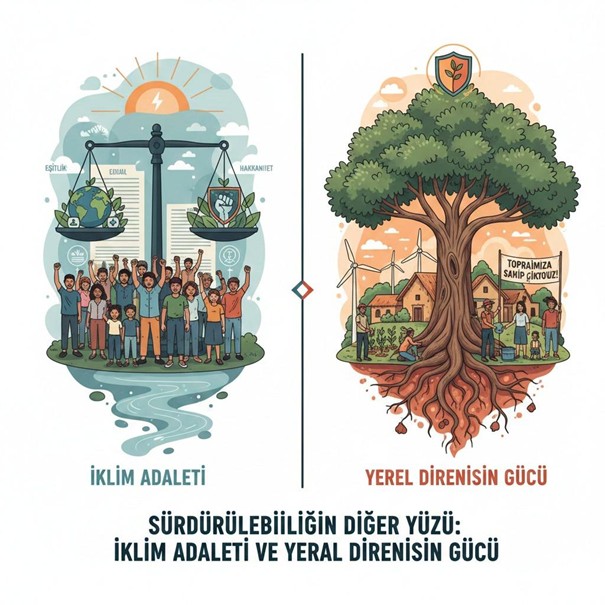
In this context, the struggle for sustainability means not only reducing carbon in the atmosphere but also addressing inequalities in decision-making mechanisms and reclaiming the rights to natural resources from corporations and returning them to the public. Sustainability is the demand for local communities to have a voice over their own living spaces — in other words, a demand for “spatial justice” (Soja, 2017).
Parallel to this search for justice over space, volunteerism within the framework of climate justice has evolved from passive action into “active ecological citizenship” (Shiva, 2021). Civil society plays three strategic roles in this process: bringing local injustices to global attention, strengthening struggles with scientific and legal foundations, and weaving organic networks of solidarity among diverse social groups.
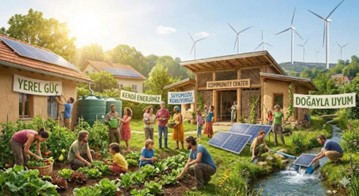
In conclusion, sustainability is not a technological race but a scale of justice (Bookchin, 2019). The solution to the climate crisis does not lie with local communities overshadowed by massive wind turbines. The solution lies in empowered local communities that generate their own energy, protect their water, and establish non-hierarchical relationships with nature.
Merve Tosun
Yücel Cultural Foundation
Volunteer Writer
References
Bookchin, M. (2019). The Ecology of Freedom.
Klein, N. (2015). This Changes Everything: Capitalism vs. The Climate.
Shiva, V. (2021). Earth Democracy.
Soja, E. W. (2017). Seeking Spatial Justice.