Existing Together: The Power of Volunteering in Building a Sustainable Society
Being aware of what is happening around us and the desire to create positive change through that awareness form the very foundation upon which volunteering flourishes. Throughout history, volunteering has endured as a social value that grows from this foundation. In Ancient Rome, when wealthy individuals financed the construction of marketplaces, roads, libraries, and baths to improve public life, this practice was called Euergetism. Similarly, in early Turkish states, individuals with favorable means offered unconditional support to those in need based on a moral understanding of sustaining society. Across different parts of the world, these acts of selfless support—whether named differently or carried out quietly—became more systematic and institutionalized within Turkish society through the waqf (foundation) tradition introduced by Islam.
Over time, volunteering—rising from the very ground in which it took root—evolved into a structure capable of generating social transformation through civil society. For volunteering to truly transform society, it must demonstrate continuity; in other words, it must be sustainable. Sustainable volunteering requires long-term responsibility and collective participation rather than momentary emotional reactions or temporary campaigns.
At this point, civil society organizations assume a crucial role. NGOs ensure the continuity of volunteering to the extent that they create spaces where volunteers can maintain their motivation and feel valued. Recognizing volunteers not merely as providers of labor but as active subjects included in decision-making processes strengthens their sense of belonging and supports the sustainability of volunteering.
From the perspective of social sustainability, volunteering is one of the fundamental elements that nurture trust, solidarity, and social capital within society. When individuals from diverse socioeconomic and cultural backgrounds come together around a shared purpose, social bonds are strengthened and a culture of “living together” develops. This process allows individuals not only to help others but also to position themselves as meaningful members of society.
Particularly for young people, volunteering holds a key role in building a sustainable society. Through volunteer activities, young people engage with social issues, gain experience in taking responsibility, and learn how to create impact. In the long term, this strengthens their awareness of active citizenship. Thus, volunteering not only addresses today’s problems but also shapes the social structure of the future.
Throughout history, volunteering has existed in different forms and has been a cornerstone of solidarity and collective existence. Yet in today’s world—marked by increasing individualism, speed, and consumer culture—preserving this value in a sustainable way is more important than ever. A sustainable society is possible not only through economic or environmental policies but through a social structure in which individuals feel responsibility toward one another, participate actively, and internalize solidarity.
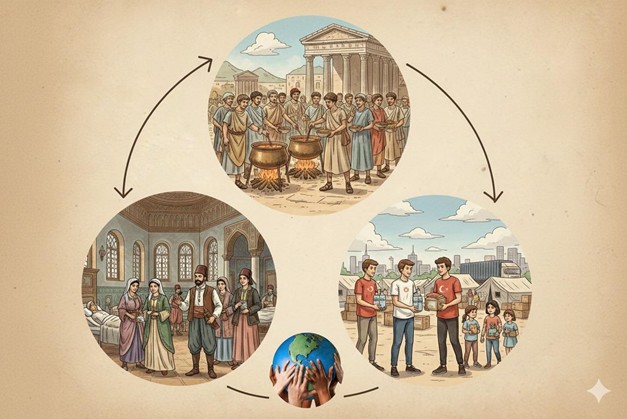
Volunteering is more than a tool in building such a structure; it is a force that holds society together. Existing together does not merely mean living in the same geography, but sharing a common sense of responsibility. For this reason, volunteering should not be regarded as a temporary act of assistance, but as a fundamental value that builds a sustainable society. Because the path to existing together passes through taking responsibility together.
Meryem Sarıyar
Yücel Cultural Foundation
Volunteer Writer